
Ideas are free. Anyone can come up with one. A great idea is just that. An idea.
Those who turn ideas into reality are deemed to have walked the walk or walked the talk.
But which one?
"Aristotle’s followers are said to have discussed philosophy while walking about with him—hence their name: “peripatetics.” I suppose they could be have been said to “walk the talk.”
For the rest of us, the saying is “if you’re going to talk the talk, you’ve got to walk the walk” — a modern version of old sayings like “actions speak louder than words” and “practice what you preach.” Another early form of the expression was “walk it like you talk it.”
"Many people now condense this to “walk the talk,” which makes a sort of sense (act on your speech), those who are more familiar with the original form as confused"
I have a great admiration for those who walked the talk (or whatever the correct phrase is) as opposed to people giving great ideas but not being able to execute those ideas. The Malaysian Government is good at giving ideas, but poor in execution. What's new eh?
30 June 2008

14 May 2008
Of Corporate Slaves and Entrepreneurs
There are two types of employment. The employee and the employer/self-employed. Salaried men and business owners. Slaves and slave drivers, or in my case, a corporate slave with many levels of slave drivers above my head.
I graduated in 1997 in BEng Mechanical & Manufacturing Systems Engineering from Cardiff University of Wales, UK. It was a grueling course for me, as I had actually lost interest half way through the course. However, I managed to recover and made it through rather well and that landed me a job in the nation's first automotive manufacturer, Proton. I had actually received the offer to work there even before my graduation. I suppose I was lucky in that sense, as you may well know that the end of 1997 was the year when things were becoming pear shape. I am referring to the Economic Crisis of 1998.
I didn't last long in Proton, but I had the opportunity, for the first time, to work in a prestigious national company that is the pride of our nation. Well, that was then. During the course of my employment, they had sent me to the US of A for almost 2 months under a research project which I enjoyed tremendously, primarily because I was sent there just before Christmas time in December and Christmas in the US means a long holiday spell, so the company I was seconded to was closed for two weeks. Needless to say, with given transportation and accommodation allowances (I had a 4 litre Grand Cherokee at my disposal), I took the opportunity to embark on a 'mini tour' of the west coast. I also managed to drive my way to Las Vegas to celebrate New Year and, get this, the start of Ramadhan all on the same day! What an experience it was.
Anyway, I digress. After about one and a half years in Proton, I had to repay my dues to my parents and took a job in Ipoh as Factory Manager in our family-run business. Although family-run, I was still the employee there and was given salary like everyone else. After two and a half years, I decided that factory life was not for me anymore and decided to pursue further studies, hoping to switch industry from manufacturing to marketing with my new found knowledge. Upon graduation however, things were not the same as before.
Due to certain circumstances, the family company had to be sold off to our principal and that left me without a job for a while. I worked with my dad for eight months doing various ventures but that didn't workout so I left and eventually found a job at Golden Hope. I was really happy to work for another national company as this entitles me to certain benefits and security, which was really important to me in times of the downturn. Anyway, to cut the story short, Golden Hope merged with Island & Peninsular and I was transfered to I&P and have been there since. This year is my fifth year in Golden Hope/I&P and my eleventh year working as an employee.
What does it feel like being an employee? Well, to me I value the job security above all things. Secondly, I believe the benefits, especially medical benefits are a big push factor into becoming an employee. Thirdly, let's just say that almost everyone I know who graduated from university works for other people, so let's just jump on the bandwagon.
I was taught by the British education system. The system trains you well to be a highly valuable employee. There are various grades and degree classes to distinguish an excellent student from a mediocre student. Grades mean everything. Some people even commit suicide for not getting enough of them. But if you really look at it, at the end of the day, it only teaches you how to manage other people's business well. We work very hard to climb the corporate ladder. We believe in the promise of reward against performance. If you perform well, you will get your bonus, and vice versa.
Well, if that's the case, then are we no different from the Egyptian slaves who were trained to build the pyramids? Since the pyramids are considered a wonder of the world, it would take a considerable amount of brain power and management skills to build them. Wouldn't it be logical to presume that a performance and reward system existed even in 2560 BC? If that's the case, then it would be fair to say that the slave drivers had already mastered the art of persuasion via the carrot and stick system which is still being practiced in the present time.
The colonial empire was very smart. They built great universities and colleges and invited 'certain privileged' royalties to study in those places. These privileged students then came back to govern Malaya using the British system. It was seen as a win win situation as the Malays get smarter, hence able to 'administer' the country better, and the British is seen as benevolent and fair.
However, there is only one thing in a mind of the past Masters, and that is total submission to their rule. Those Malays were not really privileged. In fact, they were programmed' to follow the British system and serve its Masters. They have in fact, been trained to be good, obedient slaves. They say that knowledge is power. I say that one who holds knowledge and use it to one's benefit is even more powerful than knowledge itself.
It has been in our ancestors' mindset that to succeed, you need to finish your education, get the necessary qualifications and become either a doctor, lawyer, engineer or accountant. Anything else outside of these predetermined destiny is seen as peculiar, extraordinary or even failure. In my days, I cannot imagine what the reaction would be if I were to tell my parents that I wanna be a salsa instructor or a gourmet chef when I grow up.
The prevailing belief is that if you become any one of the four above, you will land yourself a cushy job in a respectable firm/company and your future is secured. Try to be a chef or a dance instructor and you'll be faced with unpaid bills, mounting debts and flagging customers. The difference is this; the former option will lead one to becoming an employee, the other will lead to one becoming self employed. Therefore the mindset is this: become an employee, don't become self employed. Get a stable job, don't take unnecessary risks. Rise up the ranks, don't try to be a hero.
Unfortunately, the British education system has imprinted in our minds that being an employee is the best route to take, as this will guarantee you security and stable income. They have courses that tailor to every need of our employers/masters. How to become a good manager, how to handle other people's money well, how to fix things effectively when things go wrong. However, NONE of these courses actually teach you how to be RICH. Yes, being rich is our ultimate goal, isn't it? Why else would you work? It's that and being FREE. Freedom of choice. Freedom to follow your passion and ultimately, FINANCIAL FREEDOM.
Financial freedom is defined as a well-planned lifestyle where one no longer is required to work for income to cover their expenses.
Now how does that sound? Great I'm sure. It's about money making money, or letting the money work for you, or passive income or getting out of the rat race. There are many fancy terms to this, but essentially it means freeing your life from money constraints.
So let me ask you this. Hypothetically if I were to give you one million dollars, what would you do with it and how long would it last? I wouldn't be surprised if many of you are unable to answer this honestly. The fact is that, many of us weren't taught to be financially intelligent. We were not educated to become rich and stay rich. Worse, we were not told how to make money. That secret, ladies and gentlemen, only belongs to our Masters.
I have great admiration for entrepreneurs. Many of them do not have formal education. Some of them started from almost next to nothing while others continue where their parents left off. Some do it out of their desire to become independent while others do it because they have no choice. However, ALL of them take great risks to become entrepreneurs. I'd love to quote Bill Gates, a university dropout who now doesn't need introduction, or our very own Tan Sri Syed Mokhtar Al-Bukhari who started off helping his father in the cattle farming business, only to see his investment washed away by foot and month disease. He now owns a multitude of business from shipping to engineering construction to independent power producer. Do Google him in you're interested to know more.
One thing they have in common is their determination to succeed despite various failures and setbacks. I believe in the saying 'no pain no gain' and my God, they have gone through the lot and came out successful, while we are still watching them from our cushy chairs and silly small cubicles and wondering when our time will come...
Anyway, I digress. After about one and a half years in Proton, I had to repay my dues to my parents and took a job in Ipoh as Factory Manager in our family-run business. Although family-run, I was still the employee there and was given salary like everyone else. After two and a half years, I decided that factory life was not for me anymore and decided to pursue further studies, hoping to switch industry from manufacturing to marketing with my new found knowledge. Upon graduation however, things were not the same as before.
Due to certain circumstances, the family company had to be sold off to our principal and that left me without a job for a while. I worked with my dad for eight months doing various ventures but that didn't workout so I left and eventually found a job at Golden Hope. I was really happy to work for another national company as this entitles me to certain benefits and security, which was really important to me in times of the downturn. Anyway, to cut the story short, Golden Hope merged with Island & Peninsular and I was transfered to I&P and have been there since. This year is my fifth year in Golden Hope/I&P and my eleventh year working as an employee.
What does it feel like being an employee? Well, to me I value the job security above all things. Secondly, I believe the benefits, especially medical benefits are a big push factor into becoming an employee. Thirdly, let's just say that almost everyone I know who graduated from university works for other people, so let's just jump on the bandwagon.
I was taught by the British education system. The system trains you well to be a highly valuable employee. There are various grades and degree classes to distinguish an excellent student from a mediocre student. Grades mean everything. Some people even commit suicide for not getting enough of them. But if you really look at it, at the end of the day, it only teaches you how to manage other people's business well. We work very hard to climb the corporate ladder. We believe in the promise of reward against performance. If you perform well, you will get your bonus, and vice versa.
Well, if that's the case, then are we no different from the Egyptian slaves who were trained to build the pyramids? Since the pyramids are considered a wonder of the world, it would take a considerable amount of brain power and management skills to build them. Wouldn't it be logical to presume that a performance and reward system existed even in 2560 BC? If that's the case, then it would be fair to say that the slave drivers had already mastered the art of persuasion via the carrot and stick system which is still being practiced in the present time.
The colonial empire was very smart. They built great universities and colleges and invited 'certain privileged' royalties to study in those places. These privileged students then came back to govern Malaya using the British system. It was seen as a win win situation as the Malays get smarter, hence able to 'administer' the country better, and the British is seen as benevolent and fair.
However, there is only one thing in a mind of the past Masters, and that is total submission to their rule. Those Malays were not really privileged. In fact, they were programmed' to follow the British system and serve its Masters. They have in fact, been trained to be good, obedient slaves. They say that knowledge is power. I say that one who holds knowledge and use it to one's benefit is even more powerful than knowledge itself.
It has been in our ancestors' mindset that to succeed, you need to finish your education, get the necessary qualifications and become either a doctor, lawyer, engineer or accountant. Anything else outside of these predetermined destiny is seen as peculiar, extraordinary or even failure. In my days, I cannot imagine what the reaction would be if I were to tell my parents that I wanna be a salsa instructor or a gourmet chef when I grow up.
The prevailing belief is that if you become any one of the four above, you will land yourself a cushy job in a respectable firm/company and your future is secured. Try to be a chef or a dance instructor and you'll be faced with unpaid bills, mounting debts and flagging customers. The difference is this; the former option will lead one to becoming an employee, the other will lead to one becoming self employed. Therefore the mindset is this: become an employee, don't become self employed. Get a stable job, don't take unnecessary risks. Rise up the ranks, don't try to be a hero.
Unfortunately, the British education system has imprinted in our minds that being an employee is the best route to take, as this will guarantee you security and stable income. They have courses that tailor to every need of our employers/masters. How to become a good manager, how to handle other people's money well, how to fix things effectively when things go wrong. However, NONE of these courses actually teach you how to be RICH. Yes, being rich is our ultimate goal, isn't it? Why else would you work? It's that and being FREE. Freedom of choice. Freedom to follow your passion and ultimately, FINANCIAL FREEDOM.
Financial freedom is defined as a well-planned lifestyle where one no longer is required to work for income to cover their expenses.
Now how does that sound? Great I'm sure. It's about money making money, or letting the money work for you, or passive income or getting out of the rat race. There are many fancy terms to this, but essentially it means freeing your life from money constraints.
So let me ask you this. Hypothetically if I were to give you one million dollars, what would you do with it and how long would it last? I wouldn't be surprised if many of you are unable to answer this honestly. The fact is that, many of us weren't taught to be financially intelligent. We were not educated to become rich and stay rich. Worse, we were not told how to make money. That secret, ladies and gentlemen, only belongs to our Masters.
I have great admiration for entrepreneurs. Many of them do not have formal education. Some of them started from almost next to nothing while others continue where their parents left off. Some do it out of their desire to become independent while others do it because they have no choice. However, ALL of them take great risks to become entrepreneurs. I'd love to quote Bill Gates, a university dropout who now doesn't need introduction, or our very own Tan Sri Syed Mokhtar Al-Bukhari who started off helping his father in the cattle farming business, only to see his investment washed away by foot and month disease. He now owns a multitude of business from shipping to engineering construction to independent power producer. Do Google him in you're interested to know more.
One thing they have in common is their determination to succeed despite various failures and setbacks. I believe in the saying 'no pain no gain' and my God, they have gone through the lot and came out successful, while we are still watching them from our cushy chairs and silly small cubicles and wondering when our time will come...
07 May 2008
The Misunderstood Religion
We Malaysians are unique in the sense that we live in a multiracial society comprising mainly Malays, Chinese and Indian as well as minority races from Sabah and Sarawak. This was brought about by the influx of immigrants from China and India during the British colonial times where they brought in to work on the mines and estates.
For a multiracial country, Malaysia has done relatively well in managing the interests of all races so far, but that is not to say it's perfect. There are undeniably a few notable issues of concerns, e.g. bumiputra rights, racial equality and religious conversion. But credit to the Malaysians, we have faired out better than most other multiracial countries in the world.
In terms of faith, the Malays are regarded as 100% Muslims, whereas Christianity is subscribed by both the Chinese and Indians. However, the Chinese are traditionally Buddhist and the Indians are traditionally Hindus. Now, having three major religions in a melting pot of a country can be a hairy business, if things are not handled properly. There is a need for understanding, respect and tolerance between faiths, freedom of worship and a sense of countrymen in order to live in harmony with each other.
Recently however, this harmony has seen better days. There is undoubtedly a strong undercurrent of racial tension rearing its ugly head waiting to surface. Many citizens are not as tolerant as they used to be. There are many reports of racially motivated demonstrations, crime of passion, lob-sided justice served and religious fundamentalists creating havoc in this beloved country of ours. One gets to read this every day from the mainstream media (yes, even the very government-biased ones) confirming the worrying trend.
What you may ask, is causing this rift? I may not have an answer to this question, but I would like to offer you my opinion on what is happening with our society right now, which may be one of the contributing factors to it. As a Malay and a Muslim, it would be more appropriate for me to comment from this angle, it is important for a Muslim to understand what Islam truly represents. To answer this point, we have to go back 1400 years ago when Islam was founded by the Prophet Muhammad (pbuh).
Muhammad was born in Mecca and came from a wealthy family whose uncle, Abu Jahal was the ruler of Mecca. During his youthful days, Muhammad was well revered by the Meccan society so much so that he was bestowed the title 'Al Amin', which means 'The Trustworthy'. However, at the time Mecca was a metropolitan city and a well-known centre for trade. As victim of its own success, the city suffered social and moral problems like corruption, crime and other social ills - no different than a typical modern city of today. Using his influence as a member of the ruling Quraish family, Muhammad created an alliance called Hilf al-Fudul in an attempt to establish fair commercial dealing. However, despite this and many other attempts to eradicate the problems, Muhammad failed bring peace to the city. Discontented with life in Mecca, he retreated and spent his days alone contemplating a solution in a cave called Hira'. It was during this time, at 40 of age, that we met with Jibril (Gabriel) and received his first revelation from God. From then onwards, he dedicated his life to build up the new religion based on guidance from God through His angel Jibril.
The critical turning point for Islam is the Hijrah, or the exodus from the city of Mecca to the city of Yathrib. The motive behind this exodus was to flee from the oppression and presecution by the Meccan society and to seek a new beginning for his people. Muhammad found the multi-ethnic citizens of Yathrib to be welcoming although at the time four major tribes were dwelling in the city, whom are all in conflict with one another. Amongst the first things Muhammad did was to settle the longstanding grievances among the tribes. He did this by creating the Constitution of Medina (or the Medina Charter) and declared Yathrib the first Islamic state, simultaneously renaming it as Medina (or Madinnah). The Charter established a kind of alliance or federation among the eight Medinan tribes and Muslim emigrants from Mecca, which specified the rights and duties of all citizens and the relationship of the different communities in Medina. The community defined in the Constitution of Medina (Ummah) had a religious outlook but was also shaped by the practical considerations and substantially preserved the legal forms of the old Arab tribes.
I urge you to google up the Charter of Medina to understand what real democracy, racial and gender equality, freedom of worship, dispute resolutions - all the familiar terms - are all about.
Therefore, democracy is not a new term. It has been around for 1400 years but conveniently forgotten of its origins due to our ignorance of Islamic history. With our never ending quest for equality of all sorts, we engage in political rhetorics, believe in pseudo Islamic policies and even fall for the lip service of charismatic but questionable leaders when all the while, the Prophet Muhammad (pbuh) and Medina were testament to the fact that Islamic system worked and is still relevant today, as the problems faced by him were no different than the problems faced by our leaders today. Medina was, in all sense and purposes, a perfect multiracial model country, with a system that champions for equal rights and protection of all citizens regardless of race and creed. I hope you'll do some research on this, and get a pleasant surprise when you compare this with the American Bill of Rights.
I believe that Islam is a religion that can, and have, solved problems arising from a multiracial society such as in Malaysia. The basic principle of Islam is peace and tolerance, and the very essence of the word comes from the Arabic 'salam' which means peace.
Why then, if Islam and its system is so great, that Islamic nations across the world are facing a crisis of sorts from poverty to income disparity, from corruption and nepotism, and from oppression to transgression? Why can't the Palestinian issue be resolved amicably without violence and bloodshed? Why can't Iran get along with Iraq and the rest of the Arab nations? Why can't Saudi Arabia help their poor neighbours who are starving to death? Why can't Malaysia solve its crime problems? So many questions, and yet the answer has been there all the while.
We all know the West associate Islam with terrorism, oppression and draconian laws. But rather than getting angry and retaliate with guns and mortar bombs, we should put ourselves in their position and question why they think that way. Is there any Islamic country you can be proud of? Is there any Muslim nation that can be a model example of peace and tolerance? I think you already know the answer.
We Muslims must be honest and admit to our mistakes. It is we who gave them that impression. It is we who have failed our nation, we the government and its people, we the Muslims. We have inadvertently turned our back on our Prophet's teachings and the Holy Quran. God has spoken to us in this verse:
"Ye are the best of peoples, evolved for mankind, enjoining what is right, forbidding what is wrong, and believing in Allah. If only the People of the Book and faith, it were best for them: among them are some who have faith, but most of them are perverted transgressors". AQ3:110
So what have we done for ourselves? Instead of becoming the 'best of people', we became the transgressors, the oppressors and the victims.
The problem is this - we do not fully understand Islam. We were not educated to understand Islam as a concept or a way of life. Instead, we were taught about heaven and hell, about the things you can and can't do, rituals upon rituals and the notion that all non Muslims go to hell regardless, and if you want to go to heaven, you only have to profess to Islam and all will be forgiven. Islam by label, Islam by name on the identity card.
Islam was taught using scare tactics. Steal this and your hands will be chopped off. Read this verse, or else a snake from hell will come and taunt you in your grave or recite this magical verse if you wanna pass your exams. Even worse, renounce Islam and the government will persecute you and make you the front page news!
We Muslims perform lot of things seemingly Islamic, when they are not. We also presume things to be from the teachings of Islam when they are clearly not so. If you were to study the history of the Malay culture, you will find that prior to Islamisation, the Malays were largely bounded by the law of nature. Animism was the main faith, i.e. the belief in spirits and superstitions. This faith were held strongly by the Malays, so much so that some of the beliefs are even held today. Spirits, ghosts and omen still play a part in the present Malay culture even by those living in urban areas or urbanites. No stranger to this is the popular tradition of visiting the 'bomoh' or 'pawang' to ask for favours, or simply to determine one's fate in future.
When Islam came to the shores of Melaka, it brought with it a total paradigm shift, a new way of life. This changed the way Malays think and to a large extent, the Malay culture itself, one that is based on logic and reason, on knowledge acquisition and wisdom.
"It is He who brought you forth from the wombs of your mothers when ye knew nothing; and He gave you hearing and sight and intelligence: that ye may give thanks (to Allah)." AQ16:78
Over the years, the prescribed Islamic way of life becomes part of the Malay culture but some practices from the pre-Islamic era still found their way into this intertwined, prevalent Malay culture until the distinction between the original animistic and Islamic roots is blurred somewhat.
We Muslims believe in the Oneness of God. However at the same time, we are also led to believe that other forces exists which can affect our lives. Some people believe in the 'semangat' or 'saka'. For example, if the believer experiences severe depression, anxiety or a stroke of bad luck, he or she would visit the bomoh or witchdoctor who may prescribe the poor soul with a sacred talisman, or by indulging him or her in a flower bath, or by burning incense around the house or properties to ward off the evil spirits called jinns and iblis .
Although the younger generation of Muslims are more progressive thinking than their more traditional ancestors, various forms of deviations from the original Islamic teachings still manage to influence their minds. There is a lot of myth surrounding our beliefs. For example, many still believe that Muslims can't even touch pigs or dogs, deemed as dirty animals, but the Quran never prohibits Muslims from touching or even adopting them as pets (referring to dogs). In fact, dogs were used during the Prophet's times as a useful hunting animal. Another confusion is the notion that all Muslims go to heaven eventually, even thought they committed some sins during their lifetime. It was said that these souls will be punished in hell for a predetermined period and then 'transferred' to heaven when they've done their 'time'. For those who still believe in this myth, I would like you to refer to the verse 2:80 and 2:81 in the Holy Quran to see what God has to say about this.
On a serious note, these factors lead to the assumption that Islam is more about mantras and rituals, about do's and don't's and about individualism rather than focusing on the ummah. Whereas Islam IS about the ummah, or the community. It's about the system of a nation. It involves all aspects of politics, socio-economic issues and religion.
So you see, even Muslims are confused as to what Islam really is. We are still searching for the truth, but sometimes the truth is hidden from us. Well, not really. The truth has always been there, only if we'd bother to look. Yes, the truth can only be found at the only one place guaranteed by God to be trustworthy, The Holy Quran.
"And we have indeed made the Quran easy to understand and remember: then is there any that will receive admonition?" AQ54:17, 22, 32 & 40
Everything you need to know is in this book. But knowing and doing are two different things. Knowing what to do is the easy part. Verse 54:17 has said it so, the message was even repeated four times in the Surah. It's the doing part that Muslims often fail to execute. To do exactly what the Quran requires of you calls for a lot of faith, patience and hard work. We all have ideas, we all know what is right, but doing the right thing is what separates the real Muslims from the hypocrites. Now you may ask, "yes, I can read and understand the book (via translation or otherwise), but what is it telling me to do?"
It is clear that Islam represents a struggle to strive for peace and harmony. Islam is supposed to eradicate poverty, injustice and oppression. In order to achieve this, the underlying policies that govern the country must be based on the principles of equality and justice for all. Look at the Medina Charter again and see what I mean. You see, to achieve peace, we need to establish a system based on these principles. Yes, we are talking about a system here. The only way to embrace Islam in total is to have this system governing the nation.
Yes, Islam is a way of life. Islam represents a model system of governance as how Allah intended. An Islamic nation is one that is governed by principles and policies derived from the 6236 verses of the Holy Quran which contains all the necessary guidelines to establish the system.
The definition of a way of life encompasses many aspects, covering legal & judicial system, financial system and social behavior. To be called an Islamic state (like Medina), there can be only one system running the country. That system must be based on the Holy Quran. Malaysia according to our dear Deputy Prime Minister Dato' Seri Najib Tun Razak, is an Islamic country. But this Islamic country adopts not one but two sets of law governing the country, a law based on the British Law, and the Syariah Law. However the Syariah Law only applies to the Muslims whereas the British Law applies to BOTH Muslims and non-Muslims. So now we have two sets of laws for two different faiths, often one law prevails over another. These two laws are incompatible and will never be compatible. Now can you see the problem, eh Mr. Deputy Prime Minister?
"Lo! those who disbelieve in Allah and His messengers, and seek to make distinction between Allah and His messengers, and say: We believe in some and disbelieve in others, and seek to choose a way in between;" AQ4:150
"Such are disbelievers in truth; and for disbelievers We prepare a shameful doom." AQ4:151
Is it not true to say that we don't have 100% confidence in Allah's system of justice and the Al-Hikmah? Is it not true to say that we mix the two systems together because we don't think it's fair on the non-Muslims? Or that the Islamic system is outdated, passe, and irrelevant to a certain extent that we need to complement it with the British system? Did u read the verses above?
What does God say about syirik or the act of apostasy? Those who do not confirm to Allah's oneness of God is committing apostasy. While this could be interpreted in many ways, what is logical must be true. Hence, by having two beliefs, i.e. believing in the British system and the Islamic system, we have committed apostasy in the very sense of the word. We believe in Allah, His creations and His Mercy, but we also believe in the law created by humans, with all the imperfections attached, and are subjected to the mercy of our leaders (who do not totally embrace the Islamic system in the first place).
Definition of apostasy: a total desertion of or departure from one's religion, principles, party, cause, etc.
Allah created a system for us - Islam, and we choose not to fully embrace the system, rather mix and match to our liking or to suit our daily needs, have we not committed the biggest syirik of all?
No wonder Islam is a misunderstood religion. If the Muslims are themselves deluded, who can blame the non-Muslims for not understanding Islam?
For a multiracial country, Malaysia has done relatively well in managing the interests of all races so far, but that is not to say it's perfect. There are undeniably a few notable issues of concerns, e.g. bumiputra rights, racial equality and religious conversion. But credit to the Malaysians, we have faired out better than most other multiracial countries in the world.
In terms of faith, the Malays are regarded as 100% Muslims, whereas Christianity is subscribed by both the Chinese and Indians. However, the Chinese are traditionally Buddhist and the Indians are traditionally Hindus. Now, having three major religions in a melting pot of a country can be a hairy business, if things are not handled properly. There is a need for understanding, respect and tolerance between faiths, freedom of worship and a sense of countrymen in order to live in harmony with each other.
Recently however, this harmony has seen better days. There is undoubtedly a strong undercurrent of racial tension rearing its ugly head waiting to surface. Many citizens are not as tolerant as they used to be. There are many reports of racially motivated demonstrations, crime of passion, lob-sided justice served and religious fundamentalists creating havoc in this beloved country of ours. One gets to read this every day from the mainstream media (yes, even the very government-biased ones) confirming the worrying trend.
What you may ask, is causing this rift? I may not have an answer to this question, but I would like to offer you my opinion on what is happening with our society right now, which may be one of the contributing factors to it. As a Malay and a Muslim, it would be more appropriate for me to comment from this angle, it is important for a Muslim to understand what Islam truly represents. To answer this point, we have to go back 1400 years ago when Islam was founded by the Prophet Muhammad (pbuh).
Muhammad was born in Mecca and came from a wealthy family whose uncle, Abu Jahal was the ruler of Mecca. During his youthful days, Muhammad was well revered by the Meccan society so much so that he was bestowed the title 'Al Amin', which means 'The Trustworthy'. However, at the time Mecca was a metropolitan city and a well-known centre for trade. As victim of its own success, the city suffered social and moral problems like corruption, crime and other social ills - no different than a typical modern city of today. Using his influence as a member of the ruling Quraish family, Muhammad created an alliance called Hilf al-Fudul in an attempt to establish fair commercial dealing. However, despite this and many other attempts to eradicate the problems, Muhammad failed bring peace to the city. Discontented with life in Mecca, he retreated and spent his days alone contemplating a solution in a cave called Hira'. It was during this time, at 40 of age, that we met with Jibril (Gabriel) and received his first revelation from God. From then onwards, he dedicated his life to build up the new religion based on guidance from God through His angel Jibril.
The critical turning point for Islam is the Hijrah, or the exodus from the city of Mecca to the city of Yathrib. The motive behind this exodus was to flee from the oppression and presecution by the Meccan society and to seek a new beginning for his people. Muhammad found the multi-ethnic citizens of Yathrib to be welcoming although at the time four major tribes were dwelling in the city, whom are all in conflict with one another. Amongst the first things Muhammad did was to settle the longstanding grievances among the tribes. He did this by creating the Constitution of Medina (or the Medina Charter) and declared Yathrib the first Islamic state, simultaneously renaming it as Medina (or Madinnah). The Charter established a kind of alliance or federation among the eight Medinan tribes and Muslim emigrants from Mecca, which specified the rights and duties of all citizens and the relationship of the different communities in Medina. The community defined in the Constitution of Medina (Ummah) had a religious outlook but was also shaped by the practical considerations and substantially preserved the legal forms of the old Arab tribes.
I urge you to google up the Charter of Medina to understand what real democracy, racial and gender equality, freedom of worship, dispute resolutions - all the familiar terms - are all about.
Therefore, democracy is not a new term. It has been around for 1400 years but conveniently forgotten of its origins due to our ignorance of Islamic history. With our never ending quest for equality of all sorts, we engage in political rhetorics, believe in pseudo Islamic policies and even fall for the lip service of charismatic but questionable leaders when all the while, the Prophet Muhammad (pbuh) and Medina were testament to the fact that Islamic system worked and is still relevant today, as the problems faced by him were no different than the problems faced by our leaders today. Medina was, in all sense and purposes, a perfect multiracial model country, with a system that champions for equal rights and protection of all citizens regardless of race and creed. I hope you'll do some research on this, and get a pleasant surprise when you compare this with the American Bill of Rights.
I believe that Islam is a religion that can, and have, solved problems arising from a multiracial society such as in Malaysia. The basic principle of Islam is peace and tolerance, and the very essence of the word comes from the Arabic 'salam' which means peace.
Why then, if Islam and its system is so great, that Islamic nations across the world are facing a crisis of sorts from poverty to income disparity, from corruption and nepotism, and from oppression to transgression? Why can't the Palestinian issue be resolved amicably without violence and bloodshed? Why can't Iran get along with Iraq and the rest of the Arab nations? Why can't Saudi Arabia help their poor neighbours who are starving to death? Why can't Malaysia solve its crime problems? So many questions, and yet the answer has been there all the while.
We all know the West associate Islam with terrorism, oppression and draconian laws. But rather than getting angry and retaliate with guns and mortar bombs, we should put ourselves in their position and question why they think that way. Is there any Islamic country you can be proud of? Is there any Muslim nation that can be a model example of peace and tolerance? I think you already know the answer.
We Muslims must be honest and admit to our mistakes. It is we who gave them that impression. It is we who have failed our nation, we the government and its people, we the Muslims. We have inadvertently turned our back on our Prophet's teachings and the Holy Quran. God has spoken to us in this verse:
"Ye are the best of peoples, evolved for mankind, enjoining what is right, forbidding what is wrong, and believing in Allah. If only the People of the Book and faith, it were best for them: among them are some who have faith, but most of them are perverted transgressors". AQ3:110
So what have we done for ourselves? Instead of becoming the 'best of people', we became the transgressors, the oppressors and the victims.
The problem is this - we do not fully understand Islam. We were not educated to understand Islam as a concept or a way of life. Instead, we were taught about heaven and hell, about the things you can and can't do, rituals upon rituals and the notion that all non Muslims go to hell regardless, and if you want to go to heaven, you only have to profess to Islam and all will be forgiven. Islam by label, Islam by name on the identity card.
Islam was taught using scare tactics. Steal this and your hands will be chopped off. Read this verse, or else a snake from hell will come and taunt you in your grave or recite this magical verse if you wanna pass your exams. Even worse, renounce Islam and the government will persecute you and make you the front page news!
We Muslims perform lot of things seemingly Islamic, when they are not. We also presume things to be from the teachings of Islam when they are clearly not so. If you were to study the history of the Malay culture, you will find that prior to Islamisation, the Malays were largely bounded by the law of nature. Animism was the main faith, i.e. the belief in spirits and superstitions. This faith were held strongly by the Malays, so much so that some of the beliefs are even held today. Spirits, ghosts and omen still play a part in the present Malay culture even by those living in urban areas or urbanites. No stranger to this is the popular tradition of visiting the 'bomoh' or 'pawang' to ask for favours, or simply to determine one's fate in future.
When Islam came to the shores of Melaka, it brought with it a total paradigm shift, a new way of life. This changed the way Malays think and to a large extent, the Malay culture itself, one that is based on logic and reason, on knowledge acquisition and wisdom.
"It is He who brought you forth from the wombs of your mothers when ye knew nothing; and He gave you hearing and sight and intelligence: that ye may give thanks (to Allah)." AQ16:78
Over the years, the prescribed Islamic way of life becomes part of the Malay culture but some practices from the pre-Islamic era still found their way into this intertwined, prevalent Malay culture until the distinction between the original animistic and Islamic roots is blurred somewhat.
We Muslims believe in the Oneness of God. However at the same time, we are also led to believe that other forces exists which can affect our lives. Some people believe in the 'semangat' or 'saka'. For example, if the believer experiences severe depression, anxiety or a stroke of bad luck, he or she would visit the bomoh or witchdoctor who may prescribe the poor soul with a sacred talisman, or by indulging him or her in a flower bath, or by burning incense around the house or properties to ward off the evil spirits called jinns and iblis .
Although the younger generation of Muslims are more progressive thinking than their more traditional ancestors, various forms of deviations from the original Islamic teachings still manage to influence their minds. There is a lot of myth surrounding our beliefs. For example, many still believe that Muslims can't even touch pigs or dogs, deemed as dirty animals, but the Quran never prohibits Muslims from touching or even adopting them as pets (referring to dogs). In fact, dogs were used during the Prophet's times as a useful hunting animal. Another confusion is the notion that all Muslims go to heaven eventually, even thought they committed some sins during their lifetime. It was said that these souls will be punished in hell for a predetermined period and then 'transferred' to heaven when they've done their 'time'. For those who still believe in this myth, I would like you to refer to the verse 2:80 and 2:81 in the Holy Quran to see what God has to say about this.
On a serious note, these factors lead to the assumption that Islam is more about mantras and rituals, about do's and don't's and about individualism rather than focusing on the ummah. Whereas Islam IS about the ummah, or the community. It's about the system of a nation. It involves all aspects of politics, socio-economic issues and religion.
So you see, even Muslims are confused as to what Islam really is. We are still searching for the truth, but sometimes the truth is hidden from us. Well, not really. The truth has always been there, only if we'd bother to look. Yes, the truth can only be found at the only one place guaranteed by God to be trustworthy, The Holy Quran.
"And we have indeed made the Quran easy to understand and remember: then is there any that will receive admonition?" AQ54:17, 22, 32 & 40
Everything you need to know is in this book. But knowing and doing are two different things. Knowing what to do is the easy part. Verse 54:17 has said it so, the message was even repeated four times in the Surah. It's the doing part that Muslims often fail to execute. To do exactly what the Quran requires of you calls for a lot of faith, patience and hard work. We all have ideas, we all know what is right, but doing the right thing is what separates the real Muslims from the hypocrites. Now you may ask, "yes, I can read and understand the book (via translation or otherwise), but what is it telling me to do?"
It is clear that Islam represents a struggle to strive for peace and harmony. Islam is supposed to eradicate poverty, injustice and oppression. In order to achieve this, the underlying policies that govern the country must be based on the principles of equality and justice for all. Look at the Medina Charter again and see what I mean. You see, to achieve peace, we need to establish a system based on these principles. Yes, we are talking about a system here. The only way to embrace Islam in total is to have this system governing the nation.
Yes, Islam is a way of life. Islam represents a model system of governance as how Allah intended. An Islamic nation is one that is governed by principles and policies derived from the 6236 verses of the Holy Quran which contains all the necessary guidelines to establish the system.
The definition of a way of life encompasses many aspects, covering legal & judicial system, financial system and social behavior. To be called an Islamic state (like Medina), there can be only one system running the country. That system must be based on the Holy Quran. Malaysia according to our dear Deputy Prime Minister Dato' Seri Najib Tun Razak, is an Islamic country. But this Islamic country adopts not one but two sets of law governing the country, a law based on the British Law, and the Syariah Law. However the Syariah Law only applies to the Muslims whereas the British Law applies to BOTH Muslims and non-Muslims. So now we have two sets of laws for two different faiths, often one law prevails over another. These two laws are incompatible and will never be compatible. Now can you see the problem, eh Mr. Deputy Prime Minister?
"Lo! those who disbelieve in Allah and His messengers, and seek to make distinction between Allah and His messengers, and say: We believe in some and disbelieve in others, and seek to choose a way in between;" AQ4:150
"Such are disbelievers in truth; and for disbelievers We prepare a shameful doom." AQ4:151
Is it not true to say that we don't have 100% confidence in Allah's system of justice and the Al-Hikmah? Is it not true to say that we mix the two systems together because we don't think it's fair on the non-Muslims? Or that the Islamic system is outdated, passe, and irrelevant to a certain extent that we need to complement it with the British system? Did u read the verses above?
What does God say about syirik or the act of apostasy? Those who do not confirm to Allah's oneness of God is committing apostasy. While this could be interpreted in many ways, what is logical must be true. Hence, by having two beliefs, i.e. believing in the British system and the Islamic system, we have committed apostasy in the very sense of the word. We believe in Allah, His creations and His Mercy, but we also believe in the law created by humans, with all the imperfections attached, and are subjected to the mercy of our leaders (who do not totally embrace the Islamic system in the first place).
Definition of apostasy: a total desertion of or departure from one's religion, principles, party, cause, etc.
Allah created a system for us - Islam, and we choose not to fully embrace the system, rather mix and match to our liking or to suit our daily needs, have we not committed the biggest syirik of all?
No wonder Islam is a misunderstood religion. If the Muslims are themselves deluded, who can blame the non-Muslims for not understanding Islam?
14 April 2008
The List
I read with interest Hannah Yeoh's blog entry on Angsana Flats in Subang Jaya. For those who didn't know, Hannah Yeoh is one of the new generation of young MPs who got elected in the recent General Elections. She is representing Subang Jaya and she is only 29.
The entry was about her visit to Angsana Flats (you can read about it at her blog here) in USJ1 since it is a hotspot for dengue. She was disheartened, to say the least, at the living conditions of the occupants. She tells of a 12 year old orphan who has NEVER been to school. A single mother with RM300 per month to provide for her 4 boys. A blinded child who is still seeking medical treatment and doctors still unable to identify the cause.
One interesting point I picked up in her blog was how we should be remember what God has given us. We always complain of trivial things that get in our way. The same boring food, our lousy jobs, driving a small car, our low pay and the list goes on. We always forget how lucky we are until we meet those who are less fortunate than us.
Whenever we feel like complaining, she says to count your blessings. Just compare ourselves to the plight of the Angsana Flats residence. After reading her entry, I feel more inspired to complete my list. So here it is:
My Grateful List
I think I could go on and on but the point of this list is to remind me of what I should be grateful for. We always forget that. Now I do not want to forget anymore.
So what's the next step after this? I have to watch The Secret again...
The entry was about her visit to Angsana Flats (you can read about it at her blog here) in USJ1 since it is a hotspot for dengue. She was disheartened, to say the least, at the living conditions of the occupants. She tells of a 12 year old orphan who has NEVER been to school. A single mother with RM300 per month to provide for her 4 boys. A blinded child who is still seeking medical treatment and doctors still unable to identify the cause.
One interesting point I picked up in her blog was how we should be remember what God has given us. We always complain of trivial things that get in our way. The same boring food, our lousy jobs, driving a small car, our low pay and the list goes on. We always forget how lucky we are until we meet those who are less fortunate than us.
Whenever we feel like complaining, she says to count your blessings. Just compare ourselves to the plight of the Angsana Flats residence. After reading her entry, I feel more inspired to complete my list. So here it is:
My Grateful List
I am grateful:
1. to be alive
2. to have a loving wife and kids who always make me feel loved in times of sorrow and despair
3. to have a roof above my head
4. for being able to afford good and healthy food
5. to have both my parents around
6. for being given a chance to study overseas, to have found love and came back with a job waiting for me
7. to have friends around me, even if only a small number of them are truly friends
8. for not having any known enemies
9. to have a job that pays my bills, even if it sucks
10. to be relatively good at taking pictures
11. to be able to earn a side income from my passion, photography
12. to have Allah beside me and guide me through my darkest times
13. to know that Allah has not abandoned me
14. for Allah to give me strength when I'm at my weakest
15. to Allah The Most Gracious for entertaining my lust for material things:
a) my precious Honda
b) my lovely Titus MTB
c) my dream slr, especially my 18-year old used Canon EOS-1 film slr
d) my NEC and Acer notebooks and a 20-inch imac
e) a Dopod handphone, no, 2 Dopod handphones
f) Designer clothes and shoes, my Ferragamos in particular, my RC (radio controlled) toys which I always dream of having when I was little
g) my properties, even if I'm heavily in debt because of them
h) an ever growing collection of magazines which I don't know where to store them already
i) my small collection of cuff links
j) my 12-year old Rolex
1. to be alive
2. to have a loving wife and kids who always make me feel loved in times of sorrow and despair
3. to have a roof above my head
4. for being able to afford good and healthy food
5. to have both my parents around
6. for being given a chance to study overseas, to have found love and came back with a job waiting for me
7. to have friends around me, even if only a small number of them are truly friends
8. for not having any known enemies
9. to have a job that pays my bills, even if it sucks
10. to be relatively good at taking pictures
11. to be able to earn a side income from my passion, photography
12. to have Allah beside me and guide me through my darkest times
13. to know that Allah has not abandoned me
14. for Allah to give me strength when I'm at my weakest
15. to Allah The Most Gracious for entertaining my lust for material things:
a) my precious Honda
b) my lovely Titus MTB
c) my dream slr, especially my 18-year old used Canon EOS-1 film slr
d) my NEC and Acer notebooks and a 20-inch imac
e) a Dopod handphone, no, 2 Dopod handphones
f) Designer clothes and shoes, my Ferragamos in particular, my RC (radio controlled) toys which I always dream of having when I was little
g) my properties, even if I'm heavily in debt because of them
h) an ever growing collection of magazines which I don't know where to store them already
i) my small collection of cuff links
j) my 12-year old Rolex
I think I could go on and on but the point of this list is to remind me of what I should be grateful for. We always forget that. Now I do not want to forget anymore.
So what's the next step after this? I have to watch The Secret again...
13 April 2008
The Secret
Lately I've been feeling rather down. Actually I've been feeling this for quite sometime already, but it seemed to have gotten worse in recent months. I suppose I could say that I'm depressed. I think I do, although I may not show it. Why you'd say, am I feeling depressed?
Apart from feeling depressed, I also feel disappointed. Disappointed with the way things are going in my life. Disappointed with myself for making avoidable big mistakes in my life, hurting the ones who love me dearly and betraying their trust in me. Maybe I'm unhappy too. Unhappy that my career path is going nowhere, at the same time debts mounting and expenses ever increasing. When I look around and see some friends of mine, they are doing really well in their life. That made me even more depressed.
Recently I was invited to a mini reunion at one of our ex-classmate's newly completed resort-like bungalow and I was totally bewildered at seeing his achievements. This guy was in my class from Year 1 to Year 6, so I know him well and we've been friends ever since. However, we drifted apart when I left for UK and only managed to hook up again after graduation. He left for Switzerland to major in Hospitality and started landing jobs in Hotels soon after he graduated. His current job is a GM of a 5 star hotel and a director of the company.
Now, just imagine the typical life an average Joe would dream of. Let's say, a big house with a freeform swimming pool and perhaps a jacuzzi thrown in, a nice big German saloon that growls with its V8 engine, a home theater complete with Dolby's latest surround system and a job to die for. Now imagine having all that at 34 years old.
Whilst I'm very proud of what my friend has achieved and my heart is with great admiration for his achievements, I can't help but feel green with envy. I kept thinking what could I have achieved if I had chosen a different path in my life. Why is my life now less fulfilling? When can I be free of debt? Where is my dream car?
Some people may call this a mid-life crisis, but I'm only thirty something so I don't think this is the case. It's just that after 10 years in a rat race, I wonder how to get out. I'd like to achieve my financial freedom now, without having to worry about supporting me and my family adequately. I like be somebody that people can look up to and be the one who inspires the people around me. Unfortunately, I don't see that coming...
The Help
Sometimes, God has a way of sorting you out. I believe that God listens to your heart and that if your heart is sincere, He would open the doors to you. Just earlier today I came across this DVD titled "The Secret". I'm sure some of you have already heard of the book, this is the documentary adaptation from it. For those who are in the dark like me, this latest phenomenon started with Rhonda Byrne's discovery of the secret from a 100 year old book that was given to her. She then went back through the centuries, tracing and uncovering a common truth that lay at the core of the most powerful philosophies, teachings and religions in the world.
Anyway, what I can tell you about The Secret is this. It's about The Law of Attraction, the power to attract the things you like or the things you hate by using your thoughts. It's about using the power of visualization to turn dreams into reality. Without exception, every human being has the ability to transform any weakness or suffering into strength, power, perfect peace, health, and abundance. The Secret explains with simplicity the law that is governing all lives, and offers the knowledge of how to create - intentionally and effortlessly - a joyful life. This is the secret to everything - the secret to unlimited happiness, love, health and prosperity.
Finally, the answer to my prayers!! This is what I've been looking for. Come to think of it, I've come across a similar concept not too long ago whilst on a pilgrimage to a Holy place. I met a wise man there who explained to me the concept of "Ikhlas" and how he and his people helped to build a place of hope from nothing but the power of visualisation and faith (but that's another story for another time perhaps). For your info, The Quran even has a surah (verse) called Al-Ikhlas. Anyway, I digress.
One of the ways of using The Secret is to get rid of your negative thoughts or bad energy and focus on the positive thoughts or energy. To start with I shall try to remember and list down the things that I'm grateful for. I shall call this My Grateful List.
To be continued...
11 April 2008
Corporate Social Responsibility (CSR)
I am still up and awake at wee hours in the morning. I took the drowsy flu pill earlier this evening but the effect must have worn out since I'm not that sleepy anymore, and like what most people do nowadays when they couldn't sleep, I surf the internet.
I came across an interesting video interview just now by Philips Malaysia Chairman and CEO, Dr. Rajah Kumar, who also happens to be my next door neighbour. He was talking about Philip's social responsibility project on a kindergarten project which started in Batu Arang, Selangor, providing education for the very young and less fortunate, basically a kindergarten for kids whose parents are low income earners. Without going into details, here's the link for those who are interested: The video interview.
What is interesting about this interview is that Philips, a well-known electrical & electronic appliance company, has little or nothing to do in the field of education. So why is Philips dabbling into this seemingly unconnected area of business?
 Everyone knows that in order to develop a civilised and progressive society, you need a comprehensive education. Dr Rajah believes that education is not a priviledge, but rather a basic need and there is a need to begin education at a very young age. He hopes that if young children can be coaxed into enjoying themselves while learning, when they get older, they would become well-rounded generations and not high school dropouts.
Philips' core belief is sustainability and this is reflected in what they do and the products they produce. Now, I'm sure you've seen those energy-saving light bulbs that Philips is so famous for. Apparently they are big in promoting environmental awareness and personal hygene too.
 Why am I so impressed with this company? Well, wouldn't it be nice if all the multinationals or even big national companies share the same sentiment and concern about the social and economic well-being of the citizens? Some of these companies are so damn big that their annual turnovers rival the GDPs of some countries. They make tonnes of money from developed and third world countries alike and in particular, I remember ExxonMobile recently posted their last year's annual profit of about USD40.6 billion! Can you imagine how much money that is? I felt almost sick when I read the news, because I think it's perverted for ANY organisation to make such an obscene amount of money.
Now imagine if the money can be utilised to improve the living conditions of the less fortunate, provide free education and enchance the healthcare system of a nation. Poverty may be eradicated, crime rate may be reduced and society may become more healthy and educated. If only every organisation plays its part in contributing to the nation. Life would be so much better than it is now.
Ok, in all fairness some of these organisations do contribute towards CSR, but honestly, how much percentage of their profit goes towards this cause? If one can make USD40.6 billion per year, would 10% be too much to contribute towards the betterment of the society?
I think that corporations could and should play a bigger role alongside the government. For example, right now the Malaysian government is strapped for cash that is much needed to improve a lot of things. We need better public transportation, cheaper fuel, a total revamp of our failing education system, low food prices, higher purchasing power, better healthcare and the list goes on. We can't expect the taxpayers to fork out for everything, or else our taxes would be equal to half of our earnings, and that would be totally unacceptable. I think this is where big corporations come in. The burden has got to be shared between the government and the corporations alike. They have taken so much from us, and it would only be fair to return some.
 As an example, I could think of better things to do with the money other than sponsoring racing events or travelling around the globe in 4wds. This is a total wasteful of resources, which doesn't bring any benefits other than getting some 'airtime' for brand recognition. Event sponsorships cost a fortune, the returns are debatable at best. On the other hand, I fully support corporations' sponsorship for students' education but only FOR THOSE WHO REALLY DESERVE IT.
The company I work for doesn't even seriously think about contributing towards CSR. There are no community projects, no charity drive and even their donations are pretty scarce. Having said that, year after year the company posted profits of millions of ringgit. This being a Permodalan Nasional Berhad's subsidiary company and one of the biggest property company in Malaysia, I feel ashamed and embarassed for being an employee there. What have we become? Capitalists some might say...
I came across an interesting video interview just now by Philips Malaysia Chairman and CEO, Dr. Rajah Kumar, who also happens to be my next door neighbour. He was talking about Philip's social responsibility project on a kindergarten project which started in Batu Arang, Selangor, providing education for the very young and less fortunate, basically a kindergarten for kids whose parents are low income earners. Without going into details, here's the link for those who are interested: The video interview.
What is interesting about this interview is that Philips, a well-known electrical & electronic appliance company, has little or nothing to do in the field of education. So why is Philips dabbling into this seemingly unconnected area of business?
Everyone knows that in order to develop a civilised and progressive society, you need a comprehensive education. Dr Rajah believes that education is not a priviledge, but rather a basic need and there is a need to begin education at a very young age. He hopes that if young children can be coaxed into enjoying themselves while learning, when they get older, they would become well-rounded generations and not high school dropouts.Philips' core belief is sustainability and this is reflected in what they do and the products they produce. Now, I'm sure you've seen those energy-saving light bulbs that Philips is so famous for. Apparently they are big in promoting environmental awareness and personal hygene too.
 Why am I so impressed with this company? Well, wouldn't it be nice if all the multinationals or even big national companies share the same sentiment and concern about the social and economic well-being of the citizens? Some of these companies are so damn big that their annual turnovers rival the GDPs of some countries. They make tonnes of money from developed and third world countries alike and in particular, I remember ExxonMobile recently posted their last year's annual profit of about USD40.6 billion! Can you imagine how much money that is? I felt almost sick when I read the news, because I think it's perverted for ANY organisation to make such an obscene amount of money.
Now imagine if the money can be utilised to improve the living conditions of the less fortunate, provide free education and enchance the healthcare system of a nation. Poverty may be eradicated, crime rate may be reduced and society may become more healthy and educated. If only every organisation plays its part in contributing to the nation. Life would be so much better than it is now.
Ok, in all fairness some of these organisations do contribute towards CSR, but honestly, how much percentage of their profit goes towards this cause? If one can make USD40.6 billion per year, would 10% be too much to contribute towards the betterment of the society?
I think that corporations could and should play a bigger role alongside the government. For example, right now the Malaysian government is strapped for cash that is much needed to improve a lot of things. We need better public transportation, cheaper fuel, a total revamp of our failing education system, low food prices, higher purchasing power, better healthcare and the list goes on. We can't expect the taxpayers to fork out for everything, or else our taxes would be equal to half of our earnings, and that would be totally unacceptable. I think this is where big corporations come in. The burden has got to be shared between the government and the corporations alike. They have taken so much from us, and it would only be fair to return some.
 As an example, I could think of better things to do with the money other than sponsoring racing events or travelling around the globe in 4wds. This is a total wasteful of resources, which doesn't bring any benefits other than getting some 'airtime' for brand recognition. Event sponsorships cost a fortune, the returns are debatable at best. On the other hand, I fully support corporations' sponsorship for students' education but only FOR THOSE WHO REALLY DESERVE IT.
The company I work for doesn't even seriously think about contributing towards CSR. There are no community projects, no charity drive and even their donations are pretty scarce. Having said that, year after year the company posted profits of millions of ringgit. This being a Permodalan Nasional Berhad's subsidiary company and one of the biggest property company in Malaysia, I feel ashamed and embarassed for being an employee there. What have we become? Capitalists some might say...
07 April 2008
Work Life Balance

I've always been the one who champion proper work life balance. I think it's important to divide your time equally, or at least reasonably, between work and leisure. I read an article on this whilst studying in the UK and had a discussion with my mates about the very topic. The consensus was that, although many of us agree that we need time for ourselves, in reality only few of us actually do.
Work pressures, closing deadlines and deal-making opportunities often eat into our work life balance and often people readily forgo their time for leisure to satisfy their bosses or clients.
 From my experience, it's very difficult to strictly adhere to a proper work life balance especially if you're working for someone. Living in a competitive environment dictates that you have to put in extra hours in order to get anywhere. Coming in to work at 9 and leaving at 5 just wouldn't cut it. I remember when I was working in Proton a long time ago. Work didn't really start until 5pm. That's when my then boss would be free to talk to his staff and give out work, call for meetings etc. It was a culture in there (at least in my department anyway) that looked up to people who stayed back after work, regardless if they had actual work or not. I was frequently asked to come on Saturdays (it was a 5-day week organisation, except for the production shift workers), to which I refused politely. In all honesty I did come on one Saturday, only to waste my time hanging around and doing absolutely nothing. No I didn't get to claim for overtime either...
Fast forward ten years, here I am in a property industry, having the same dilemma of keeping the work life balance right and pleasing my superiors at the same time. You know what? Now I can say, sod it! I do have life after work so if you want me to stay back, you gotta pay me! Yes, I couldn't care less if they think less of me, as I got other things to do, like making side income, attending to my family and friends, or simply just time alone for myself. Yes yes, I do have a life...barely. And I need to cherish what little of it I have.
So, what about you? Do you believe in a proper work life balance?
04 April 2008
A Long Lasting Passion
Why photography?
To answer this question, I have to recall back to almost 17 years ago (1991) when, on the way back from the UK for my Summer holidays, I picked up an in-flight magazine (Wings of Gold from Malaysia Airlines) and read an article on cameras and photography.
The article described the current technology in cameras and what they are capable of doing. I was pretty impressed with the word 'predictive' focus, a follow focus mode that can track a moving subject and predict where the subject will be prior to pressing the shutter button. Being a technogeek by nature didn't help to suppress my curiosity and I read the article over and over again. Suffice to say i brought the magazine home and started to dabble in the world of photography.
I'm not alien to photography, in fact I had my first camera when I was 6 years old. It was a Fuji point and shoot but it used a 110 cartridge film like below:
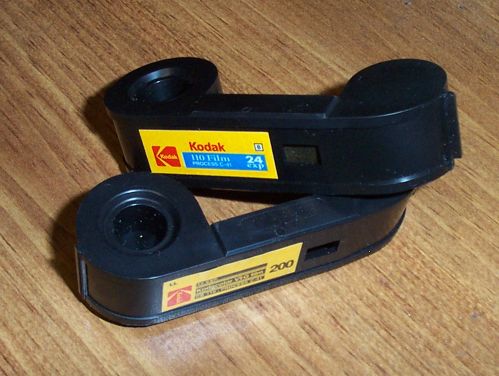 I really liked the camera but it was lost after a trip to Singapore if I remember correctly. Anyway, I was given another Fuji camera as a gift back in 1987 I think but it was a simple fixed focus plastic point and shoot. However, it used a normal 135mm film which was a great relief. It was the only camera I had and used in the UK during my early years of study there.
This camera went everywhere with me, from the sunny and sandy island of Penang to the snow cold temperatures of Berkshire in winter. So I'm kinda familiar with photography at a relatively early age compared to most kids in those days.
Anyway, the article in the magazine changed my mode of photography from being a casual snapper to wanting to become a more serious photographer. In all honestly, this was mainly driven by the technological side as opposed to the artistic side. I just wanted to experience the 'predictive focus' so widely touted in the article. The article claims that the 3-zone evaluative metering of the new Canon EOS1000 can detect backlight subjects and adjust accordingly, and that using the AL-Focus mode, the camera can detect whether the subject is moving or stationary. Cool!!
My summer holidays started from June to August, I had also just sat for my GCSE exams before the end of term, and the result would come out by end August. It was the happiest moment of my life when all pressures are off and I had total freedom to do whatever I like during my holidays. During those period I had actually forgotten completely about photography, not until something happened just after I had gotten my GCSE results.
The Trip
It was 22nd August 1991, and we were on the way to Penang. It was late in the evening and as usual, we stopped over at my grandma's house in Bagan Serai (which is en route to Penang using the old road). I had just spoken to her over the phone earlier to inform her of my GCSE results, which turned out quite well in fact. Needless to say, she was ecstatic to hear about them and I told her that we'll be going to Penang later in the evening.
She was watching tv when we arrived and I came to hug and kiss her as usual. My brother Danial had a sudden urge to go to the bathroom (which was probably the main reason why we stopped over in the first place) and off he went with my mother. I can't remember for sure but I think we had dinner there too, and said our goodbyes before we left. She was still in front of the tv and she looked very elegant with a clean facial expression. I hugged her and told her that we'll stop by again on the way home. Then off we went...
The trip to Penang can be quite a lethargic one since at the time, there was no highway that connects Ipoh to Penang directly. The highway ends at Changkat Jering and we had to take the old road all the way to Penang. That was then.
 Upon arrival at our Mont Pleasure condo, we unhooked the mobile Ericsson Hotline Phone from the car and brought it back to the condo complete with the lead acid battery that weighed a ton. I went to bed early since I had a long day, and all was fine until the next morning.
"Bangun sayang! Bangun!", mother said.
"Hmmmmph...errr... apa? Apa?" I said, still dazed and confused.
"Pah dah takde!!", she said again.
"Huh? What?", I said.
As soon as it came to me that my beloved grandma has left this world for good, I went straight into the showers and tried to make sense at what has happened. Tears started to flow and I could barely control myself soon after. We rushed back to Bagan Serai and upon arrival, I went straight to see my grandma's motionless body. From then on, it was all blurry and numb.
The Passion
Now what has photography got to do with this??
Simple. The loss of my grandmother had a tremendous effect on me. I was very very close to her, maybe even closer than to my own parents. I never fail to visit her every time I come back for my holidays. I felt lost, confused and despair. I needed something to occupy my mind. Hence I decide to bite the bullet and take up photography with the purchase of my first slr camera. I also figured the need to photograph precious events and people that you love and matter to you, because you never know when they will be gone forever.
 I took out my saving of RM1000 and splashed on my new found hobby. A thousand bucks was a lot of money then (even now) but for the sake of keeping me alive and sane, I went through with it.
I was relatively happy with my new toy, and went over the manual like a good novel. I particularly tried out the famous 'predictive focus' and 'AL-Focus' mode and checked out the 3-zone evaluative metering. I was pretty impressed overall.
The only reason I chose this Canon camera was because of the technology it carried compared to the Nikon counterpart and the small budget I had. You see, a friend of mine had a Nikon before this and I was pretty impressed with the camera. However, it cost a cool RM3k or thereabouts and it was way way outta my budget. So I had to settle for this. (To all the Nikonians, you should consider this a compliment from me!)
So that's my story on how I got involved into this passion for a long long time already. The rest, as they say, is history...
To answer this question, I have to recall back to almost 17 years ago (1991) when, on the way back from the UK for my Summer holidays, I picked up an in-flight magazine (Wings of Gold from Malaysia Airlines) and read an article on cameras and photography.
The article described the current technology in cameras and what they are capable of doing. I was pretty impressed with the word 'predictive' focus, a follow focus mode that can track a moving subject and predict where the subject will be prior to pressing the shutter button. Being a technogeek by nature didn't help to suppress my curiosity and I read the article over and over again. Suffice to say i brought the magazine home and started to dabble in the world of photography.
I'm not alien to photography, in fact I had my first camera when I was 6 years old. It was a Fuji point and shoot but it used a 110 cartridge film like below:
I really liked the camera but it was lost after a trip to Singapore if I remember correctly. Anyway, I was given another Fuji camera as a gift back in 1987 I think but it was a simple fixed focus plastic point and shoot. However, it used a normal 135mm film which was a great relief. It was the only camera I had and used in the UK during my early years of study there.This camera went everywhere with me, from the sunny and sandy island of Penang to the snow cold temperatures of Berkshire in winter. So I'm kinda familiar with photography at a relatively early age compared to most kids in those days.
Anyway, the article in the magazine changed my mode of photography from being a casual snapper to wanting to become a more serious photographer. In all honestly, this was mainly driven by the technological side as opposed to the artistic side. I just wanted to experience the 'predictive focus' so widely touted in the article. The article claims that the 3-zone evaluative metering of the new Canon EOS1000 can detect backlight subjects and adjust accordingly, and that using the AL-Focus mode, the camera can detect whether the subject is moving or stationary. Cool!!
My summer holidays started from June to August, I had also just sat for my GCSE exams before the end of term, and the result would come out by end August. It was the happiest moment of my life when all pressures are off and I had total freedom to do whatever I like during my holidays. During those period I had actually forgotten completely about photography, not until something happened just after I had gotten my GCSE results.
The Trip
It was 22nd August 1991, and we were on the way to Penang. It was late in the evening and as usual, we stopped over at my grandma's house in Bagan Serai (which is en route to Penang using the old road). I had just spoken to her over the phone earlier to inform her of my GCSE results, which turned out quite well in fact. Needless to say, she was ecstatic to hear about them and I told her that we'll be going to Penang later in the evening.
She was watching tv when we arrived and I came to hug and kiss her as usual. My brother Danial had a sudden urge to go to the bathroom (which was probably the main reason why we stopped over in the first place) and off he went with my mother. I can't remember for sure but I think we had dinner there too, and said our goodbyes before we left. She was still in front of the tv and she looked very elegant with a clean facial expression. I hugged her and told her that we'll stop by again on the way home. Then off we went...
The trip to Penang can be quite a lethargic one since at the time, there was no highway that connects Ipoh to Penang directly. The highway ends at Changkat Jering and we had to take the old road all the way to Penang. That was then.
Upon arrival at our Mont Pleasure condo, we unhooked the mobile Ericsson Hotline Phone from the car and brought it back to the condo complete with the lead acid battery that weighed a ton. I went to bed early since I had a long day, and all was fine until the next morning."Bangun sayang! Bangun!", mother said.
"Hmmmmph...errr... apa? Apa?" I said, still dazed and confused.
"Pah dah takde!!", she said again.
"Huh? What?", I said.
As soon as it came to me that my beloved grandma has left this world for good, I went straight into the showers and tried to make sense at what has happened. Tears started to flow and I could barely control myself soon after. We rushed back to Bagan Serai and upon arrival, I went straight to see my grandma's motionless body. From then on, it was all blurry and numb.
The Passion
Now what has photography got to do with this??
Simple. The loss of my grandmother had a tremendous effect on me. I was very very close to her, maybe even closer than to my own parents. I never fail to visit her every time I come back for my holidays. I felt lost, confused and despair. I needed something to occupy my mind. Hence I decide to bite the bullet and take up photography with the purchase of my first slr camera. I also figured the need to photograph precious events and people that you love and matter to you, because you never know when they will be gone forever.
 I took out my saving of RM1000 and splashed on my new found hobby. A thousand bucks was a lot of money then (even now) but for the sake of keeping me alive and sane, I went through with it.
I was relatively happy with my new toy, and went over the manual like a good novel. I particularly tried out the famous 'predictive focus' and 'AL-Focus' mode and checked out the 3-zone evaluative metering. I was pretty impressed overall.
The only reason I chose this Canon camera was because of the technology it carried compared to the Nikon counterpart and the small budget I had. You see, a friend of mine had a Nikon before this and I was pretty impressed with the camera. However, it cost a cool RM3k or thereabouts and it was way way outta my budget. So I had to settle for this. (To all the Nikonians, you should consider this a compliment from me!)
So that's my story on how I got involved into this passion for a long long time already. The rest, as they say, is history...
03 April 2008
All By Myself
Selfish
The title aptly describes the typical me. All by myself. Yes, that's what I'm usually like. Despite having 195 friends in Facebook, 63 contacts in Friendster, 55 in Myspace and more in Flickr, I'm actually alone here in this world. Yes, I have a family too, but hmm... nevermind.
Someone told me that I'm a selfish person. Somehow I agree with her. I am selfish. I was trained to be selfish. It's part of my childhood survival. In case you're wondering, I didn't have a normal childhood, but I guess I'm no different than most kids of my time. You gotta be selfish to survive. If you don't think for yourself, no one will.
Well, that's how I was brought up. I brought myself up. Yes yes, I was put in a boarding school at a very young age and was left to defend myself against the cultureshock, bully (it was kinda legal in those days), and more crucially, left to defend myself against the onset feeling of loneliness. Oh boy, was I lonely in those days... all alone, and I was only 14.
I had just turned 14 when I was asked to pack up in 3 days and fly off to UK to begin my new life there. Now, that would have been great to most people, but I had never left home before that. I had a docile but stable life. No boarding school, no summer camp, nadda. And suddenly this...
I was put in an all boys school in England. I remember vividly the whole saga, from the day my parents broke the news till my first day at my new school. I arrived in Heathrow on Thursday evening, probably around 6pm, in early autumn, which was already getting dark at that time. My parents rented an apartment called Parkwest in Edgware Rd. I remember the tungsten lights in the house, as the English dislike flourescent lights like we do here in Malaysia. It was all yellowish and rather dim, and it reeks of curry (somehow cooking asian food in UK makes ur house stink, probably because of the low humidity in the air).
Anyway, that night we decided to have dinner in one of the kebab restaurants there called Halal. Yes, there is halal food in London! Now you can see how naive I was then. It was the best kebab I ever tasted. Not to mention it was the FIRST kebab I ever tasted.
Whilst I rather enjoyed being in a foreign land where the air is much colder than my hometown Ipoh, plus the fact that smoke comes out of your mouth when you speak (that was really cool!), it was a period of disbelieve. I was totally overwhelmed by the whole situation. Just as yesterday I was in Ipoh, going about my usual routine to school and meeting my usual group of friends, and suddenly I was brought into this foreign land (I boarded the flight on my own and was stopped at the immigration department for being a suspicious runaway renegade with all but GBP50 in my pocket, but that's another story) with absolutely no idea of what's gonna happen to me from then on. I had totally submitted to the situation. I knew that tomorrow will be a new life for me, and that I would have to adapt, absorb, tolerate and relent to what's to come. Heck, all these were playing in my mind as I munched my kebab in the company of my parents.
A New Day
It was a Friday morning when I was woken up by my mother. It must have been 7 in the morning but lost the track of time. I had even lost my sense of bearing, thinking that I was still back at home. Gimme a break! I'm still suffering from shock and disbelief, also jetlag. Apparently, jetlag screws up your sleeping time, as I found out later in the week.
Anyway, she told me that it's time to go shopping for stuff. I remember going to Oxford Street and heading for Marks & Spencer to look for thermals and duvet. Thermals are insulating clothing you wear next to your skin. It keeps your balls from freezing in the cold, amongst other things. A duvet is a thick blanket and it bloody cost an arm (GBP60 I think it was). Apparently I was told that these are the essentials, as later I would find out how true this was. We headed home after the shopping spree and if I can recall correctly (mind you this was in Sept 1988 so my memory is a bit rusty u know!) they brought me to my new school later that afternoon.
It was called Pangbourne College. The drive from London West End to Pangbourne was approximately 45 minutes in a Volkswagen Golf, but felt longer since my heart didn't stop pounding throughout the journey. I was nervous. Very nervous. I remember taking the M4 motorway, exit at No 11. What is Pangbourne College like you might ask? Now, in the absence of the Internet (we didn't even know that computers can be hooked up to a network in those days, and the screen couldn't display graphics or pictures. Heck, the word Internet wasn't even created then), the next best place to look for information was the encyclopedia. Yes, boys and girls, do make note of this word.
Definition of encyclopedia: "A work containing information on all subjects, or limited to a special field or subject, arranged in a systematic order. Encyclopedias may be in one volume, or they may be in many volumes in which the various matters will be treated comprehensively."
I had looked up Pangbourne College from my mother's encyclopedia before I flew off to the UK. To my surprised, there was a mention on the school. I was pretty chuffed to find it in there, but failed to imagine what the school looks like as there were no pictures attached. Oh well, at least I knew it was a Naval College. A WHAT?? WTF is this???
A freaking military school!! Oh God, I'm really gonna die this time. I had no freaking idea what military college is all about. I've heard stories about it (the Royal Military College in Malaysia or RMC is probably the only military college that I know of then) and they were gruesome stories about torture, ragging, and err... faggoty moments! What have they gotten me into this time? I'm so gonna be fucked! Not literally I mean.
Upon arrival at Pangbourne College, we met with some folks sporting blonde hair and blue eyes speaking in an accent I find hard to understand. It was very weird standing and talking to these people, a totally surreal experience. Wow, I thought. This is just like the TV series Mind Your Language! Unfortunately I couldn't converse much. You know, the English accent is kinda difficult to pickup, especially on the first day (ok, second day) of being in a foreign land!
Our first stop was the Seamstress. What the heck is a Seamstress? Well, it seems that it is a place to buy your school clothes. Ok! Simple enuff. Just tryout for size and off you go. Or so I thought. The first thing I notice was that I had to wear 3 uniforms and a burberry for when it rains/snows. A burberry is like a raincoat, only that it doesn't repel rain and you can still be drenched by the British downpour. Funny these English people. I suppose waterproof nylon wasn't invented in the UK so they had to make do with wool. Oh another thing, I have to wear these hideous looking black-laced leather shoes too. I call them 'kasut motorboat', or motorboat shoes by the sound they make when one walks in them. Wearing them made me look like a 70 year old! No way dude, I'm not wearing those. I wanna wear my white sneakers! Damn!!! I'm really gonna feel outta place here...
Next stop was my new hall of residence. They put me in a house called Hesperus. You see, there were 5 houses or divisions as they called it there. Hesperus, Harbinger, McQuarie, Port Jackson and Illawara divisions. Now I was starting to feel military already. Heck!
We first went to see the Housemaster by the name of David Harris. He lived in a separate 2-story duplex apartment attached to the house itself. He introduced himself and asked me questions about myself and my educational background. I remembered my mom telling me to say "yes sir" whenever he asked me stuff, and not "yeah" like the Americans do. Mothers!! You can't live without them.
Mr Harris called in a cute boy by the name of Alex to help me settle in. His name was Alex Knight but I only remembered his first name at the time. He immediately reminded me of my then best friend Cican. Funny how the brain tries to relate everything to something you're familiar with. In truth, he looks nothing like Cican. Hmmm, my mind was still in shock u see. Alex took me to the dormitory on the top floor which was to be my room for the next three terms or so. Actually I should say our room as I had to share with 9 or 10 other white boys. They all looked like 7 year olds except for one lanky dude. This was my first time sharing a place to sleep with other boys. Weirdness rating 8/10. I had the bed nearest to the door, which I was glad as I didn't wanna be sandwiched between two strangers. So after all that introduction and a brief tour of the house, we went back to see Mr Harris.
Since it was a Friday, he said to let me spend a night here and take me back home tomorrow but to come back by Sunday night. Yes! I'm going back to London after all. I just have to survive one nite here in Pangbourne. How hard can it be? Are you kidding me??
I remember the first night. Cold, cold, cold! I shivered until I slept. And that was under a 3- layer duvet made by Dorma. It was the thickest duvet in the dorm! Owh I'm so gonna die this time. I didn't manage to chat much with my new found dorm mates as I was really tired from all the stressful events leading up to my first day at school. It seemed that I had no rest and no time to reflect upon the events that unfolded. Also, my English was crap and I didn't wanna make a fool of myself.
The next day, my parents came to pick me up and I was ever so glad to see them again. In all fairness, it must have been difficult for them too, but hey, I was the one being thrown into this new life. It was a surreal experience to say the least, and I couldn't believe I'm going through this phase of my life at such an early and immature age. The events that unfolded from then on shaped my life to what I have become today...
Someone told me that I'm a selfish person. Somehow I agree with her. I am selfish. I was trained to be selfish. It's part of my childhood survival. In case you're wondering, I didn't have a normal childhood, but I guess I'm no different than most kids of my time. You gotta be selfish to survive. If you don't think for yourself, no one will.
Well, that's how I was brought up. I brought myself up. Yes yes, I was put in a boarding school at a very young age and was left to defend myself against the cultureshock, bully (it was kinda legal in those days), and more crucially, left to defend myself against the onset feeling of loneliness. Oh boy, was I lonely in those days... all alone, and I was only 14.
I had just turned 14 when I was asked to pack up in 3 days and fly off to UK to begin my new life there. Now, that would have been great to most people, but I had never left home before that. I had a docile but stable life. No boarding school, no summer camp, nadda. And suddenly this...
I was put in an all boys school in England. I remember vividly the whole saga, from the day my parents broke the news till my first day at my new school. I arrived in Heathrow on Thursday evening, probably around 6pm, in early autumn, which was already getting dark at that time. My parents rented an apartment called Parkwest in Edgware Rd. I remember the tungsten lights in the house, as the English dislike flourescent lights like we do here in Malaysia. It was all yellowish and rather dim, and it reeks of curry (somehow cooking asian food in UK makes ur house stink, probably because of the low humidity in the air).
Anyway, that night we decided to have dinner in one of the kebab restaurants there called Halal. Yes, there is halal food in London! Now you can see how naive I was then. It was the best kebab I ever tasted. Not to mention it was the FIRST kebab I ever tasted.
Whilst I rather enjoyed being in a foreign land where the air is much colder than my hometown Ipoh, plus the fact that smoke comes out of your mouth when you speak (that was really cool!), it was a period of disbelieve. I was totally overwhelmed by the whole situation. Just as yesterday I was in Ipoh, going about my usual routine to school and meeting my usual group of friends, and suddenly I was brought into this foreign land (I boarded the flight on my own and was stopped at the immigration department for being a suspicious runaway renegade with all but GBP50 in my pocket, but that's another story) with absolutely no idea of what's gonna happen to me from then on. I had totally submitted to the situation. I knew that tomorrow will be a new life for me, and that I would have to adapt, absorb, tolerate and relent to what's to come. Heck, all these were playing in my mind as I munched my kebab in the company of my parents.
A New Day
It was a Friday morning when I was woken up by my mother. It must have been 7 in the morning but lost the track of time. I had even lost my sense of bearing, thinking that I was still back at home. Gimme a break! I'm still suffering from shock and disbelief, also jetlag. Apparently, jetlag screws up your sleeping time, as I found out later in the week.
Anyway, she told me that it's time to go shopping for stuff. I remember going to Oxford Street and heading for Marks & Spencer to look for thermals and duvet. Thermals are insulating clothing you wear next to your skin. It keeps your balls from freezing in the cold, amongst other things. A duvet is a thick blanket and it bloody cost an arm (GBP60 I think it was). Apparently I was told that these are the essentials, as later I would find out how true this was. We headed home after the shopping spree and if I can recall correctly (mind you this was in Sept 1988 so my memory is a bit rusty u know!) they brought me to my new school later that afternoon.
It was called Pangbourne College. The drive from London West End to Pangbourne was approximately 45 minutes in a Volkswagen Golf, but felt longer since my heart didn't stop pounding throughout the journey. I was nervous. Very nervous. I remember taking the M4 motorway, exit at No 11. What is Pangbourne College like you might ask? Now, in the absence of the Internet (we didn't even know that computers can be hooked up to a network in those days, and the screen couldn't display graphics or pictures. Heck, the word Internet wasn't even created then), the next best place to look for information was the encyclopedia. Yes, boys and girls, do make note of this word.
Definition of encyclopedia: "A work containing information on all subjects, or limited to a special field or subject, arranged in a systematic order. Encyclopedias may be in one volume, or they may be in many volumes in which the various matters will be treated comprehensively."
I had looked up Pangbourne College from my mother's encyclopedia before I flew off to the UK. To my surprised, there was a mention on the school. I was pretty chuffed to find it in there, but failed to imagine what the school looks like as there were no pictures attached. Oh well, at least I knew it was a Naval College. A WHAT?? WTF is this???
A freaking military school!! Oh God, I'm really gonna die this time. I had no freaking idea what military college is all about. I've heard stories about it (the Royal Military College in Malaysia or RMC is probably the only military college that I know of then) and they were gruesome stories about torture, ragging, and err... faggoty moments! What have they gotten me into this time? I'm so gonna be fucked! Not literally I mean.
Upon arrival at Pangbourne College, we met with some folks sporting blonde hair and blue eyes speaking in an accent I find hard to understand. It was very weird standing and talking to these people, a totally surreal experience. Wow, I thought. This is just like the TV series Mind Your Language! Unfortunately I couldn't converse much. You know, the English accent is kinda difficult to pickup, especially on the first day (ok, second day) of being in a foreign land!
Our first stop was the Seamstress. What the heck is a Seamstress? Well, it seems that it is a place to buy your school clothes. Ok! Simple enuff. Just tryout for size and off you go. Or so I thought. The first thing I notice was that I had to wear 3 uniforms and a burberry for when it rains/snows. A burberry is like a raincoat, only that it doesn't repel rain and you can still be drenched by the British downpour. Funny these English people. I suppose waterproof nylon wasn't invented in the UK so they had to make do with wool. Oh another thing, I have to wear these hideous looking black-laced leather shoes too. I call them 'kasut motorboat', or motorboat shoes by the sound they make when one walks in them. Wearing them made me look like a 70 year old! No way dude, I'm not wearing those. I wanna wear my white sneakers! Damn!!! I'm really gonna feel outta place here...
Next stop was my new hall of residence. They put me in a house called Hesperus. You see, there were 5 houses or divisions as they called it there. Hesperus, Harbinger, McQuarie, Port Jackson and Illawara divisions. Now I was starting to feel military already. Heck!
We first went to see the Housemaster by the name of David Harris. He lived in a separate 2-story duplex apartment attached to the house itself. He introduced himself and asked me questions about myself and my educational background. I remembered my mom telling me to say "yes sir" whenever he asked me stuff, and not "yeah" like the Americans do. Mothers!! You can't live without them.
Mr Harris called in a cute boy by the name of Alex to help me settle in. His name was Alex Knight but I only remembered his first name at the time. He immediately reminded me of my then best friend Cican. Funny how the brain tries to relate everything to something you're familiar with. In truth, he looks nothing like Cican. Hmmm, my mind was still in shock u see. Alex took me to the dormitory on the top floor which was to be my room for the next three terms or so. Actually I should say our room as I had to share with 9 or 10 other white boys. They all looked like 7 year olds except for one lanky dude. This was my first time sharing a place to sleep with other boys. Weirdness rating 8/10. I had the bed nearest to the door, which I was glad as I didn't wanna be sandwiched between two strangers. So after all that introduction and a brief tour of the house, we went back to see Mr Harris.
Since it was a Friday, he said to let me spend a night here and take me back home tomorrow but to come back by Sunday night. Yes! I'm going back to London after all. I just have to survive one nite here in Pangbourne. How hard can it be? Are you kidding me??
I remember the first night. Cold, cold, cold! I shivered until I slept. And that was under a 3- layer duvet made by Dorma. It was the thickest duvet in the dorm! Owh I'm so gonna die this time. I didn't manage to chat much with my new found dorm mates as I was really tired from all the stressful events leading up to my first day at school. It seemed that I had no rest and no time to reflect upon the events that unfolded. Also, my English was crap and I didn't wanna make a fool of myself.
The next day, my parents came to pick me up and I was ever so glad to see them again. In all fairness, it must have been difficult for them too, but hey, I was the one being thrown into this new life. It was a surreal experience to say the least, and I couldn't believe I'm going through this phase of my life at such an early and immature age. The events that unfolded from then on shaped my life to what I have become today...
Subscribe to:
Posts (Atom)

